Before you spend $10,000 or more on a solar setup, you deserve to know exactly when it pays for itself — and how much it earns you after that. The good news is the math isn’t complicated. This guide walks you through the full payback calculation, shows you what affects your ROI the most, and gives you state-by-state context so you can set realistic expectations for your specific location.
What Is the Solar Payback Period?
Your payback period is simply the number of years it takes for your electricity savings to equal your upfront system cost. After that breakeven point, every kilowatt-hour your panels produce is essentially free money.
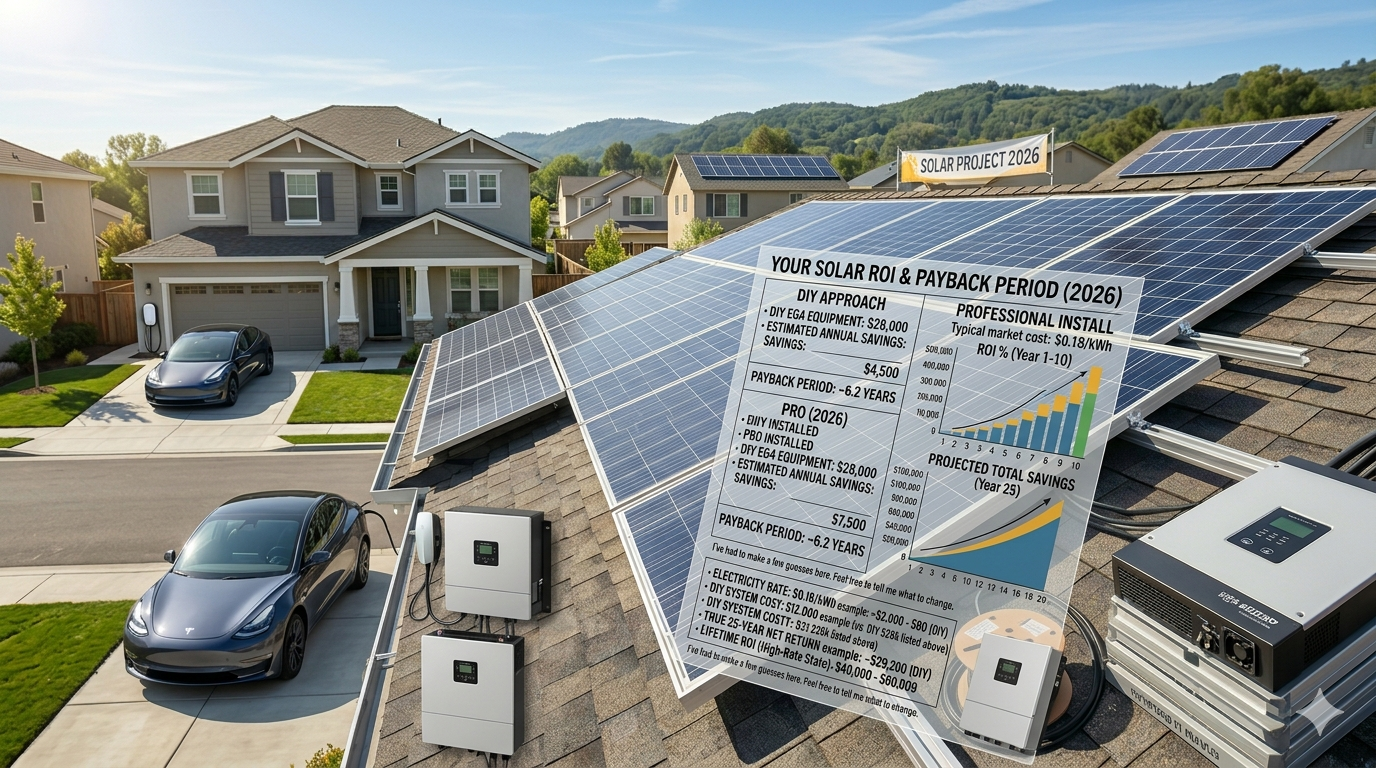
The national average solar payback period in 2026 sits at 8.7 years for professionally installed systems. For DIY installs — where you cut $8,000–$15,000 off the upfront cost — payback drops to 3–6 years for a grid-tied system. Since quality solar panels carry 25-year production warranties, that leaves 15–20+ years of near-free electricity after you break even.
The Payback Formula (Keep It Simple)
Here’s the calculation every solar buyer should run before signing anything:
Payback Period (years) = Total Net System Cost ÷ Annual Electricity Savings
That’s it. Two numbers. Let’s work through a real example:
- System cost: $12,000 (DIY 8 kW system, all components and permits)
- Annual solar production: 9,600 kWh (8 kW × 1,200 peak sun hours in a moderate climate)
- Local electricity rate: $0.18/kWh
- Annual savings: 9,600 × $0.18 = $1,728/year
- Payback period: $12,000 ÷ $1,728 = 6.9 years
After year 7, that system produces free electricity for the next 18+ years. At flat rates, that’s another $31,000+ in savings. And since electricity rates keep climbing (up 5–8% in many states this year alone), the real number is significantly higher.
The Five Factors That Move Your Payback Date the Most
1. Your Current Electricity Rate
This is the single biggest variable in your ROI calculation. Every kilowatt-hour your panels produce displaces grid electricity at your current rate. Homeowners paying $0.30/kWh (California, Connecticut, Hawaii, New York) save almost twice as much annually as homeowners paying $0.16/kWh (much of the South and Midwest) for the same system size.
2. Your System Cost (DIY vs. Pro)
A $26,000 professional installation on the same roof takes years longer to pay back than a $12,000 DIY equivalent. Reducing upfront cost is the fastest way to accelerate your ROI — which is why DIY solar payback periods are so much shorter than professional install payback periods.
3. Peak Sun Hours in Your Location
A 5 kW system in Phoenix (6.5+ peak sun hours/day) produces about 35% more electricity annually than the same system in Seattle (3.5–4 peak sun hours/day). More production means more savings and faster payback. You can find your area’s peak sun hours on the NREL solar resource map — this number is essential for any honest payback calculation.
4. Net Metering Policy
Net metering lets you sell excess solar electricity back to the grid, offsetting your bill when your panels produce more than you use (typically midday). States with full retail-rate net metering (meaning you get credited at the same rate you’d pay for electricity) see the best ROI. States that have weakened net metering — like California under NEM 3.0 — see reduced export credits, which tilts the math toward adding battery storage to use more of your own production.
5. Tax Credits and State Incentives
The federal 30% Residential Clean Energy Tax Credit expired December 31, 2025, and is no longer available for new 2026 installations. This meaningfully changes the ROI math compared to previous years. However, many states have their own incentive programs, net metering rules, property tax exemptions, and solar rebates that still add up to thousands in savings. Connecticut, New York, Massachusetts, and several other high-rate states have strong state-level programs that partially compensate for the lost federal credit.
Payback Period by State: What to Expect in 2026
Location matters enormously. Here’s a realistic snapshot of payback periods across different regions for a DIY solar install (no federal credit):
| State / Region | Avg. Electricity Rate | DIY Payback Period | Why |
|---|---|---|---|
| California | $0.28–$0.35/kWh | 4–6 years | Very high rates, lots of sun, but NEM 3.0 reduces export value |
| Connecticut | ~$0.25/kWh | 5–7 years | High rates + state incentive program + full net metering |
| New York | $0.22–$0.31/kWh | 5–7 years | High rates, good state programs, NYC has higher install costs |
| Texas | $0.13–$0.17/kWh | 7–10 years | Lots of sun but lower rates; no state income tax credit |
| Florida | $0.14–$0.16/kWh | 7–10 years | Strong sun, lower rates, property tax exemption helps |
| Pacific Northwest | $0.10–$0.13/kWh | 10–14 years | Low rates + less sun = longer payback, still positive lifetime ROI |
These ranges assume a DIY install without the federal tax credit. Add 2–4 years for professionally installed systems at retail prices.
Beyond Payback: What’s the Total Lifetime ROI?
Payback period tells you when you break even. But the more interesting number is how much you make over the full system lifetime.
Let’s run a 25-year projection for that earlier example (8 kW DIY system, $12,000 cost, $1,728/year savings at flat rates):
- Total savings over 25 years at flat rate: $1,728 × 25 = $43,200
- Less system cost: $43,200 − $12,000 = $31,200 net profit
- Minus inverter replacement at year 13: −$2,000
- True 25-year net return: ~$29,200
And that’s at completely flat electricity rates — which history suggests is a very conservative assumption. A 3% annual electricity rate increase (well below 2026’s actual rate increases in many states) adds another $10,000–$15,000 to that figure over 25 years.
In high-rate states like California, Connecticut, or New York, lifetime ROI on a well-sized DIY solar system routinely reaches $40,000–$80,000.
How to Run Your Own Calculation in 5 Minutes
- Find your annual kWh usage — it’s on your utility bill. Divide by 12 to get monthly, then check your bill directly for annual total.
- Look up your average electricity rate — also on your bill, usually expressed as cents per kWh.
- Find your peak sun hours — NREL’s PVWatts calculator (pvwatts.nrel.gov) gives a precise number for any US address, plus an estimated annual production for a given system size.
- Calculate annual savings: Estimated annual production (kWh) × your electricity rate = annual savings.
- Divide your net system cost by annual savings = your payback period.
Run this calculation before you commit to a system size. It will also tell you whether adding battery storage improves or extends your payback (usually extends it slightly, but adds outage protection and maximizes self-consumption in net metering-unfriendly states).
What Happens After Payback?
After your system has paid for itself, you’re generating electricity at effectively zero marginal cost. High-quality N-type panels are rated to produce at 85%+ efficiency after 25–30 years. Your inverter will likely need one replacement in that window ($1,500–$2,500 for a string inverter). Your LiFePO4 batteries — if you installed storage — will last 10–15 years and may need one replacement cycle.
Even accounting for those maintenance costs, the post-payback decade-plus represents pure financial gain. And if you sell your home, solar installations consistently add value — studies routinely show buyers pay a premium for homes with existing solar systems.
The Bottom Line
Solar ROI is real, and for most US homeowners in 2026 — especially those in high-rate states doing DIY installs — it’s compelling. The loss of the federal tax credit makes the math less favorable than it was in 2024–2025, but rising electricity rates and falling component costs are pulling in the opposite direction. Run your own numbers with real local data, not national averages. Your payback period is unique to your roof, your location, and your energy usage.
Have questions about your specific numbers? Share your electricity rate and location in the comments and we’ll help you work through the calculation.
Related posts you might like:
→ How Much Does a DIY Solar Setup Actually Cost in 2026?
→ DIY Solar vs. Hiring an Installer: Is the Savings Worth It?
→ How to Navigate Solar Permits Without Losing Your Mind