Walk into any solar forum and the battery debate is always raging. LiFePO4 fans swear nothing else comes close. Lead-acid loyalists point to price. AGM sits somewhere in the middle, trying to please everyone. The truth is, the right battery depends on your setup, your budget, and how long you plan to run it. This guide cuts through the noise and gives you the real numbers to make an informed decision.
The Three Contenders: A Quick Primer
Before we get into the head-to-head, here’s a plain-English summary of what each chemistry actually is:
- Flooded Lead-Acid (FLA): The oldest technology. Cheap upfront, requires regular maintenance (checking water levels, cleaning terminals), and must be kept upright. Still found in older off-grid systems and golf carts.
- AGM (Absorbent Glass Mat): A sealed, maintenance-free version of lead-acid. Fine fiberglass mats absorb the electrolyte, making them spill-proof and more vibration-resistant. A meaningful upgrade over flooded lead-acid but still fundamentally lead-acid chemistry.
- LiFePO4 (Lithium Iron Phosphate): The newest of the three. Uses lithium iron phosphate as the cathode material, which gives it exceptional thermal stability — meaning it doesn’t catch fire the way other lithium-ion chemistries can. The current gold standard for solar storage.
The Numbers That Actually Matter
Cycle Life: How Long Will It Last?
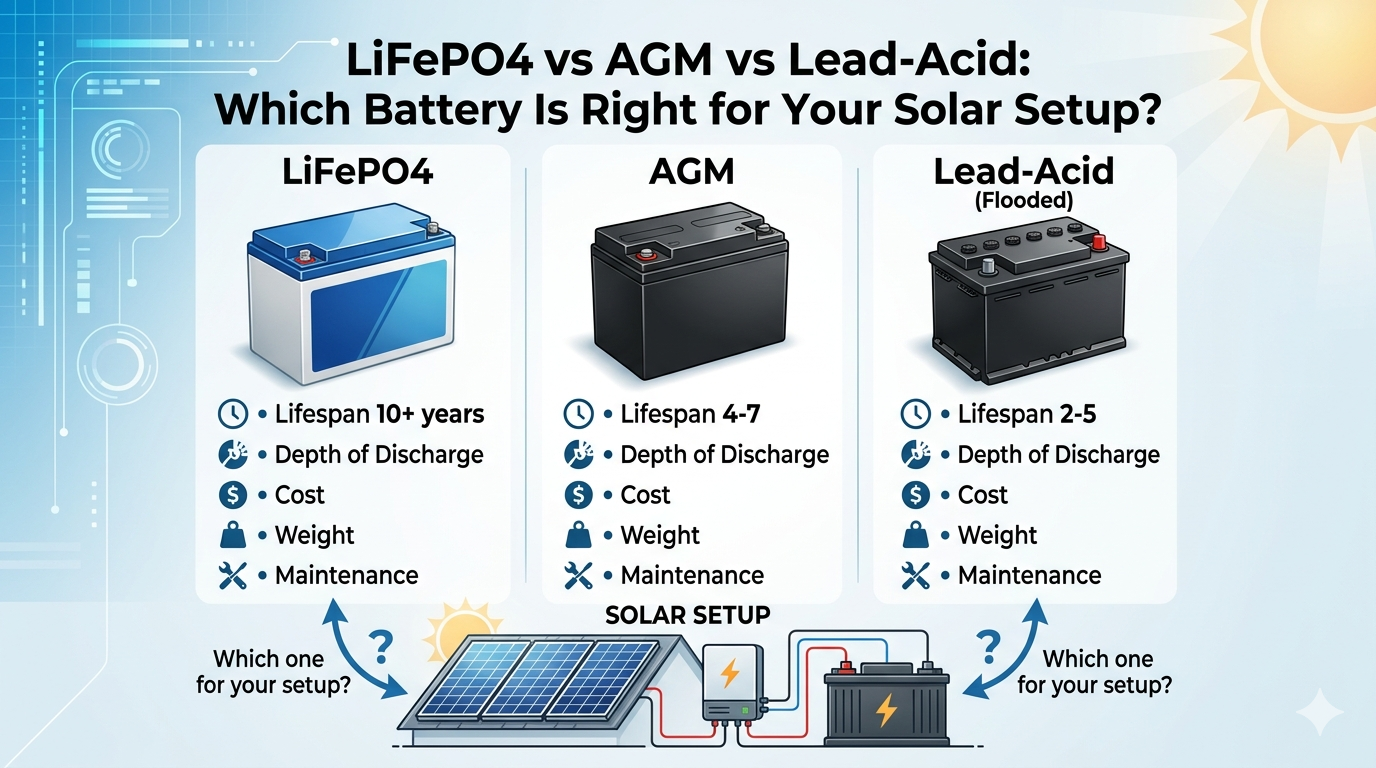
This is where the gap between lithium and lead-acid becomes impossible to ignore. LiFePO4 batteries deliver between 3,000 and 10,000 charge/discharge cycles before capacity drops noticeably. AGM batteries typically offer 500 to 1,500 cycles. Flooded lead-acid is in a similar range to AGM, often less with heavy use.
Put in real-world terms: a LiFePO4 battery cycled once per day lasts 10–15+ years. An AGM battery doing the same thing lasts 3–5 years before it needs replacing. That replacement cost matters a lot when you’re calculating true lifetime value.
Usable Capacity: The Number Manufacturers Don’t Advertise
This is the detail that trips up most first-time buyers. The rated capacity on a battery label is not what you can actually use without damaging it — that depends on Depth of Discharge (DoD).
- LiFePO4: Safe to use 80–100% of rated capacity daily
- AGM: Safe to use about 50% of rated capacity before performance degrades
- Flooded Lead-Acid: Same as AGM — 50% DoD recommended
What this means in practice: a 200Ah AGM battery only gives you 100Ah of usable power. A 200Ah LiFePO4 gives you 160–200Ah. To match the usable capacity of a single 200Ah LiFePO4, you’d need to buy 400Ah worth of AGM — and carry nearly double the weight.
Weight: A Real-World Factor
A 12V 100Ah LiFePO4 battery weighs around 24–28 lbs. An equivalent AGM weighs 63–69 lbs. For home setups this matters less, but for RV, van life, and portable systems, this difference is enormous.
Charging Speed
LiFePO4 batteries can charge 4–5 times faster than AGM, and they can handle deep discharge cycles repeatedly without performance loss. Charge retention is also superior — LiFePO4 holds its charge with minimal self-discharge over weeks and months.
Safety
LiFePO4 uses iron phosphate as the cathode material, which significantly reduces thermal runaway risk — the dangerous runaway heating that causes lithium battery fires. AGM and lead-acid carry risks from acid leaks and (in flooded versions) potentially explosive hydrogen gas buildup. For enclosed spaces like vans, cabins, and battery rooms, LiFePO4 is the clear safety winner.
Side-by-Side Comparison Table
| Feature | LiFePO4 | AGM | Flooded Lead-Acid |
|---|---|---|---|
| Cycle Life | 3,000–10,000+ | 500–1,500 | 300–800 |
| Usable Capacity (DoD) | 80–100% | ~50% | ~50% |
| Lifespan (daily cycling) | 10–15+ years | 3–5 years | 3–7 years |
| Weight (12V 100Ah) | 24–28 lbs | 63–69 lbs | 60–70 lbs |
| Charging Speed | Fast (1–2 hrs) | Slow (8–16 hrs) | Very slow |
| Maintenance | None | Minimal | Regular (watering) |
| Upfront Cost (100Ah) | $200–$400 | $120–$200 | $80–$150 |
| Thermal Safety | Excellent | Good | Moderate (gas risk) |
The Real Cost Comparison Over Time
This is where the AGM “budget” argument completely falls apart. Let’s compare a 10kWh usable storage system over 10 years:
LiFePO4 route: Buy once, covers the full 10 years. Total cost: $4,000–$6,000.
AGM route: Remember, you only get 50% usable capacity — so you need to buy 20kWh of rated capacity to get 10kWh usable. And you’ll replace it twice in 10 years. Total cost: $8,000–$12,000+, plus the labor of replacing it twice.
Lead-acid looks cheap. It isn’t — it’s just cheap upfront.
Real talk: LiFePO4 costs $400–$600 per kWh for solid budget brands in 2026, versus $150–$300/kWh for lead-acid. But when you factor in usable capacity and lifespan, LiFePO4 is consistently the better financial decision for anyone planning to run their system for more than 3–4 years.
So When Does AGM or Lead-Acid Make Sense?
There are still a few legitimate cases for the older chemistries:
- Very short-term or temporary setups where you won’t run the system long enough to recoup the LiFePO4 premium
- Extremely tight budgets where upfront cost is the only consideration and long-term ROI isn’t viable
- Cold climates without a heated battery space — LiFePO4 doesn’t charge well below freezing (though many modern units include built-in heaters)
- Applications where weight genuinely doesn’t matter and you already own lead-acid batteries
Outside of these edge cases, LiFePO4 wins on almost every metric that matters for a solar setup.
The Verdict
If you’re building a DIY solar system in 2026 and plan to use it for more than a few years — buy LiFePO4. The higher upfront cost is real, but the math is clear: longer cycle life, more usable capacity, faster charging, lighter weight, and no maintenance. AGM and flooded lead-acid are legacy technologies at this point, kept alive mainly by their lower sticker price.
When shopping, aim for the $88–$120/kWh sweet spot from brands with proven community track records like EG4, LiTime, SOK, or Renogy. Avoid anything suspiciously cheap with no BMS specs listed — the Battery Management System is what protects your investment, and cutting corners there is where things go wrong.
Questions about which specific battery fits your system size? Drop them in the comments below.
Related posts you might like:
→ DIY Solar Battery Backup Kits: What’s Worth It in 2026
→ How to Build a DIY Solar Battery Bank from Scratch
→ How Long Will My Solar Battery Last? A Real-World Sizing Guide