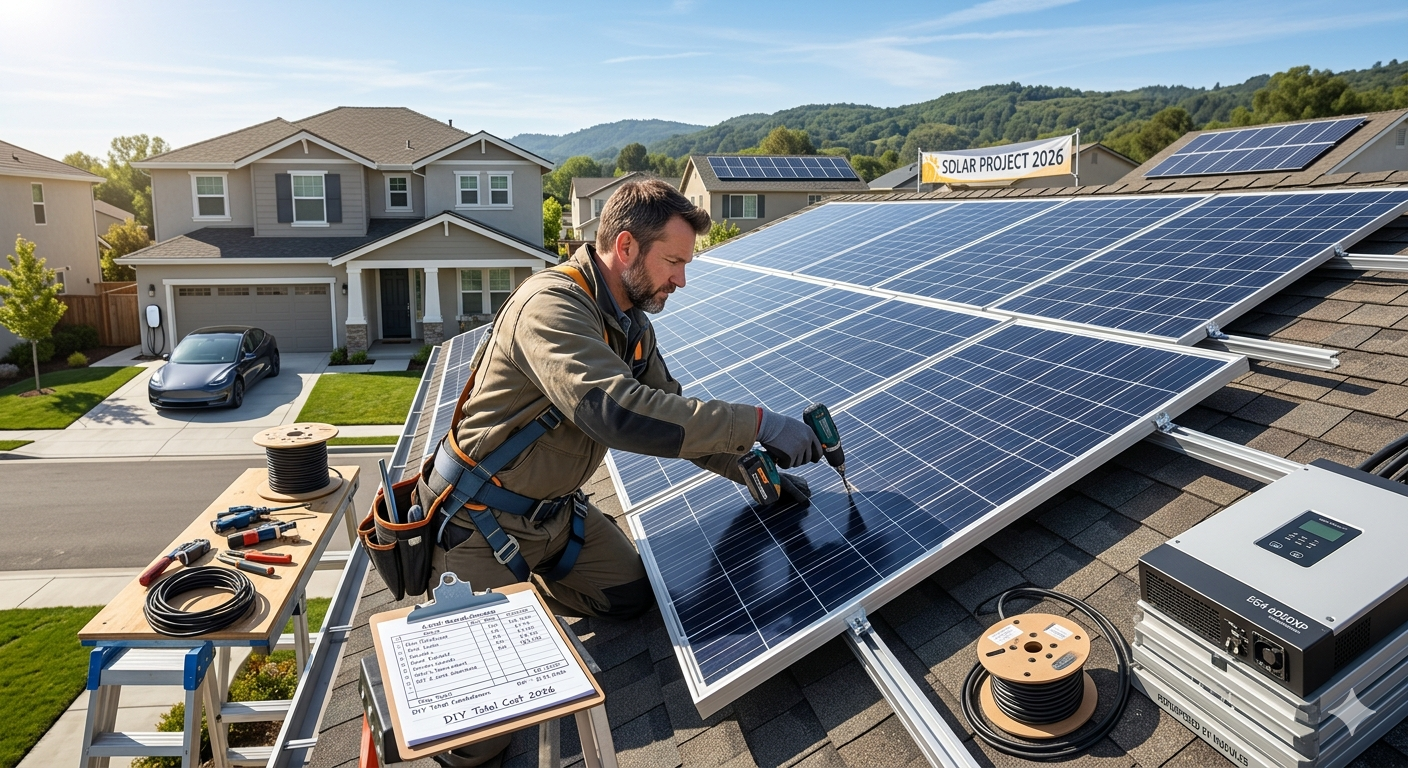
The number one question people ask before going solar is simple: what’s this actually going to cost me? The answer depends heavily on whether you hire a professional or do it yourself — and the gap between the two is larger than most people expect. This guide breaks down every cost you’ll encounter in a DIY solar setup in 2026, with real numbers, no fluff, and no hidden surprises.
The Big Picture: DIY vs. Pro Installation Costs
Let’s start with the number that changes everything. Professional solar installers in 2026 charge a national average of $2.75–$3.25 per watt installed. That means:
- Small home system (4–6 kW): $11,000–$20,000
- Medium home system (7–10 kW): $18,000–$30,000
- Large home system (11–15 kW): $28,000–$45,000
DIY components — the same panels, inverters, and hardware — run $1.20–$1.80 per watt. That means a DIYer building an 8 kW system pays roughly $9,600–$14,400 in parts versus $22,000–$26,000 professionally installed. You’re looking at savings of $8,000–$15,000 or more on a typical home system.
That gap exists because professional installers carry significant overhead: labor, workers’ compensation insurance, marketing costs, administrative expenses, and profit margin. When you do it yourself, you eliminate all of that — you just pay for parts and your own time.
Component-by-Component Cost Breakdown
Here’s what you’ll actually be buying and what to budget for each piece in 2026:
Solar Panels
In 2026, N-type monocrystalline panels are the gold standard, hitting up to 25% efficiency. Budget for $0.50–$1.50 per watt depending on brand and quality. For a 5 kW array (roughly 10–12 panels), expect to spend $2,500–$7,500. Premium brands cost more but come with 25-year production warranties and better shade tolerance — worth it for a roof installation you won’t want to redo.
Inverter
Your inverter converts DC solar power to AC power your home can use. This is not the place to cut corners. Options and typical costs:
- String inverter: $1,000–$3,000. Most affordable, works well for unshaded roofs. Will likely need replacement once around the 12–15 year mark ($1,500–$2,500).
- Microinverters: $2,700–$10,200 for a full array. One per panel, ideal for shaded or complex roofs. Often carry a 25-year warranty matching the panels.
- Hybrid inverter/charger (for battery systems): $800–$2,500. Manages panels, battery, and grid simultaneously. Required if you’re adding battery storage.
Battery Storage (Optional but Increasingly Popular)
Adding battery backup is the biggest cost variable. LiFePO4 batteries — the only chemistry worth buying — run $400–$600 per kWh for quality budget brands, up to $1,200/kWh for premium names. A 10 kWh DIY LiFePO4 bank costs roughly $4,000–$6,000 in components. A Tesla Powerwall 3 (13.5 kWh) installed professionally runs about $9,200 — the DIY equivalent costs roughly one-third of that.
MPPT Charge Controller
Required for any battery system. A quality MPPT controller sized for a 5–10 kW system runs $150–$600. Always MPPT, never PWM — the efficiency difference pays for the upgrade quickly.
Racking and Mounting Hardware
The rails, clamps, and roof attachments that hold your panels in place. Budget $500–$1,500 for a typical residential roof system. Flush-mount racking for asphalt shingles is the most straightforward DIY installation.
Wiring, Conduit, Connectors, and Fusing
This category is easy to underestimate. MC4 connectors, appropriately gauged copper cable, conduit, junction boxes, DC disconnect switches, AC breakers, and Class T fuses add up. Budget $400–$1,000 for a complete system.
Permits and Inspection Fees
Required in nearly every municipality for a grid-tied system. Permit fees typically run $300–$1,000 depending on your jurisdiction. Some areas that use SolarAPP+ offer same-day approvals at the low end of that range.
Electrician for Final Connection
Most jurisdictions require a licensed electrician to make the final connection to your main service panel and sign off before the utility will issue Permission to Operate. This typically costs $500–$1,200 for a one-day visit — an investment that protects your insurance coverage and ensures grid interconnection approval. Don’t skip this step.
Tools (One-Time Cost)
If you don’t already own them: a torque wrench, MC4 crimping tool, quality multimeter, wire strippers, and safety harness. Budget $200–$500 for a complete tool set you’ll use for the life of the system.
Total DIY System Cost Summary
| System Size | DIY Component Cost | Pro Installation Cost | DIY Savings |
|---|---|---|---|
| 3 kW (small home/cabin) | $3,600–$5,400 | $8,000–$12,000 | $4,000–$7,000 |
| 5 kW (average home) | $6,000–$9,000 | $13,000–$18,000 | $7,000–$10,000 |
| 8 kW (larger home) | $9,600–$14,400 | $20,000–$28,000 | $10,000–$15,000 |
| 10 kW + battery backup | $14,000–$22,000 | $35,000–$50,000 | $15,000–$28,000 |
All figures are component costs only, before any tax credits or rebates. Add $1,500–$3,500 for permits, electrician sign-off, and miscellaneous costs.
Tax Credits and Incentives in 2026
Important 2026 update: The federal 30% Residential Clean Energy Tax Credit (Section 25D) expired December 31, 2025 and is not available for systems installed in 2026 or later. If your system was installed and placed in service by December 31, 2025, you may still claim it on your 2025 return — but new installations no longer qualify for the federal credit.
This makes state and local incentives more important than ever in 2026. Many states have their own solar incentive programs, net metering policies, and property tax exemptions that significantly reduce your effective system cost. Check your state’s energy office website before finalizing your budget — incentives vary dramatically and can still add up to thousands of dollars in savings.
Hidden Costs to Budget For
These don’t always show up in the headline numbers but are real costs experienced DIYers plan for:
- Roof inspection and repair: If your roof has less than 10 years of life left, fix it before mounting panels. Removing and remounting a solar array to re-roof costs $1,500–$4,000 in labor alone.
- Electrical panel upgrade: Homes with 100-amp service panels often need an upgrade to 200-amp to handle solar properly. Budget $500–$2,000 if needed.
- Utility interconnection fees: Some utilities charge application and interconnection fees ranging from $100 to $500.
- Inverter replacement (long-term): String inverters typically need replacement around year 12–15. Budget $1,500–$2,500 as a long-term maintenance reserve.
Is the DIY Savings Worth It?
The honest answer: yes, for the right person. If you’re comfortable with basic electrical work, can safely work on a roof, and are willing to invest the time to understand the permitting process, DIY solar is one of the best value home improvement projects available in 2026.
If heights make you nervous, you have a complex multi-plane roof, or electrical work feels like a foreign language — a professional install is still a smart investment. You’ll pay more upfront, but you get warranties on labor, professional-grade system design, and someone to call when something goes wrong.
The middle path — buying your own components and hiring an electrician for the final connection and any complex wiring — often gives you 70–80% of the DIY savings with significantly less risk. That’s the approach a lot of experienced DIYers recommend for first-timers.
Related posts you might like:
→ DIY Solar vs. Hiring an Installer: Is the Savings Worth It?
→ Solar Panel Payback Period: How to Calculate Your Real ROI
→ How to Navigate Solar Permits Without Losing Your Mind