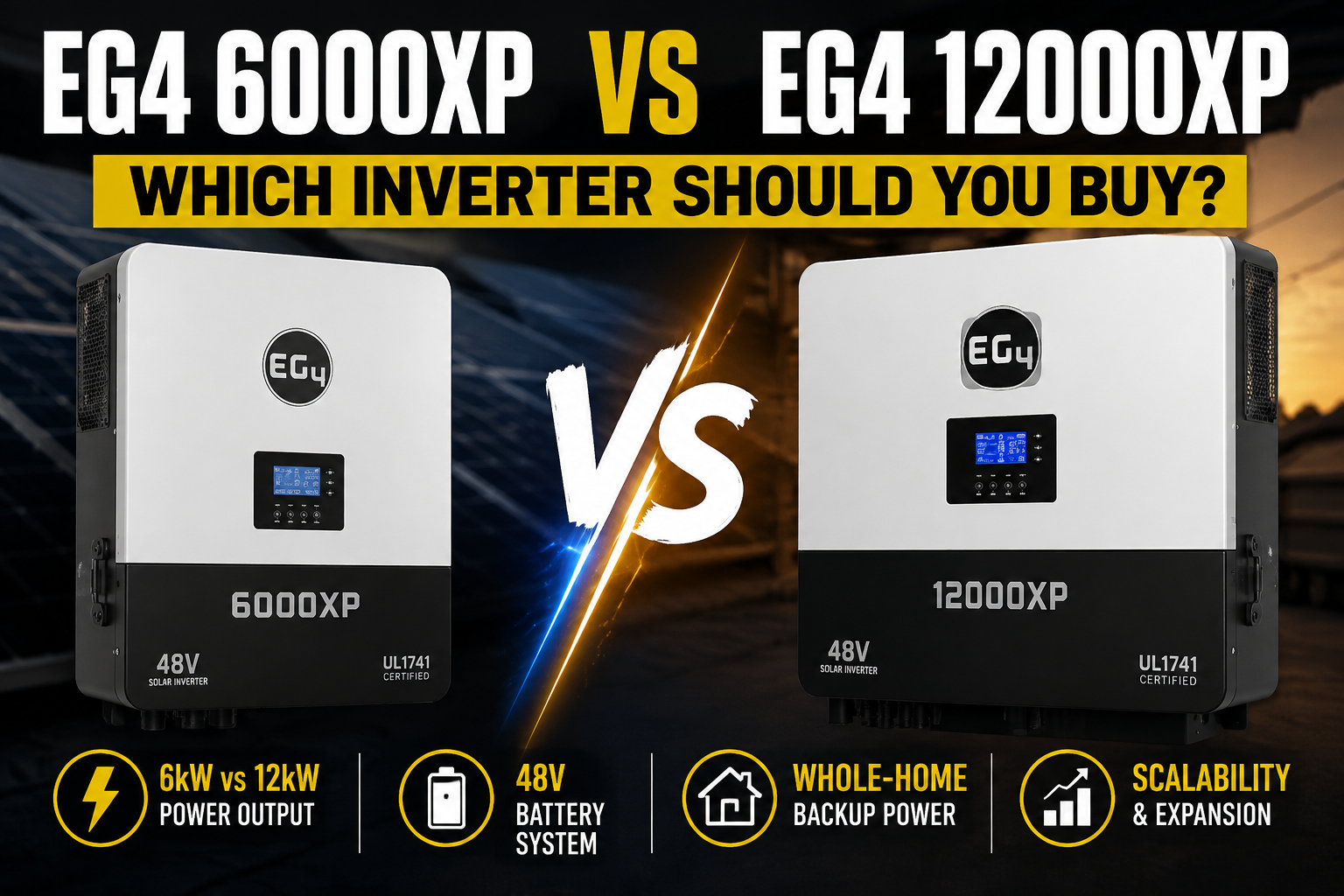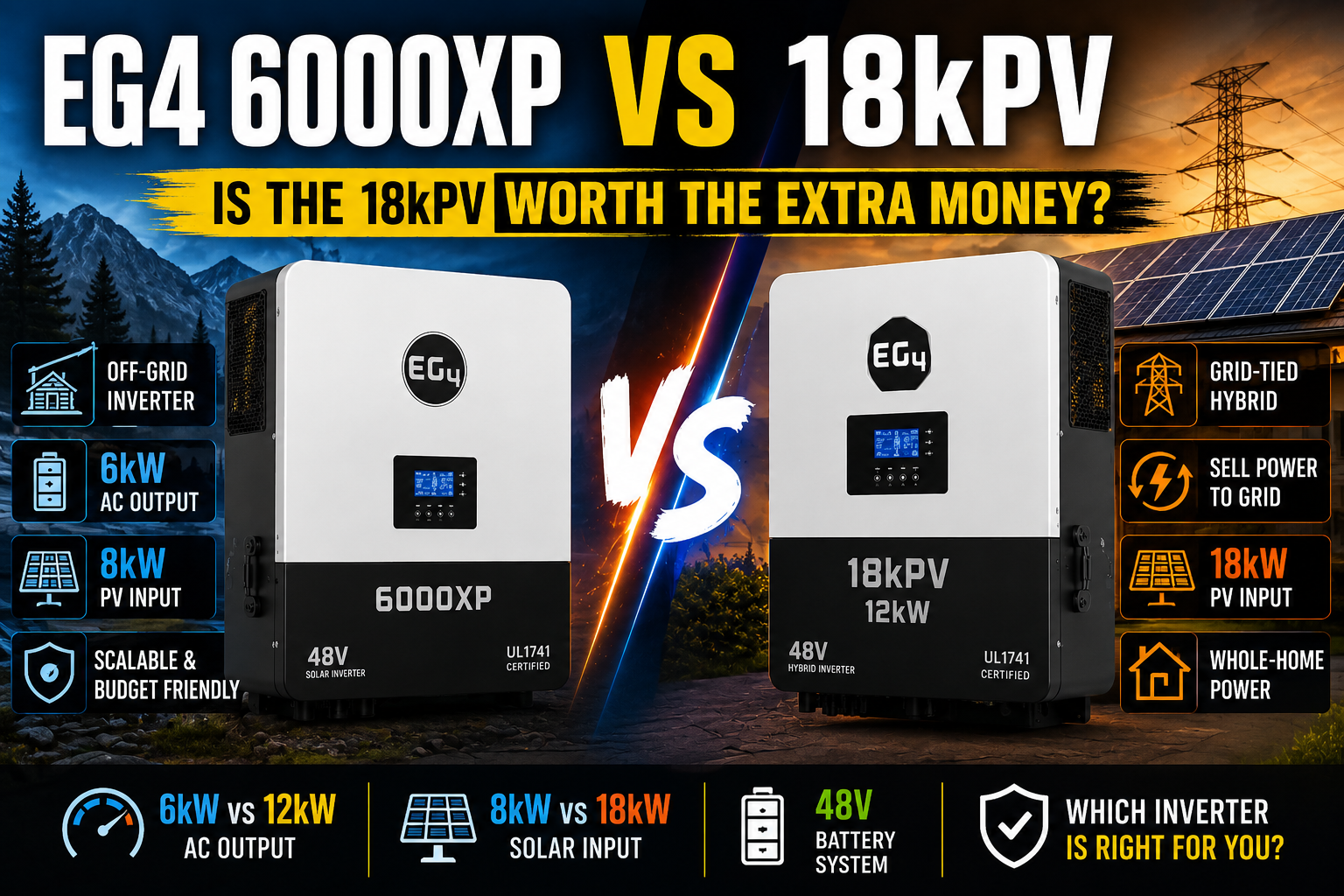
EG4 6000XP vs 18kPV
If you’re putting together a DIY solar system, two EG4 inverters you’re likely to come across are the EG4 6000XP and the EG4 18kPV.
At first glance, it might seem like the main difference is simply power. The EG4 6000XP provides 6,000 watts of continuous AC output, while the EG4 18kPV provides 12,000 watts.
But that’s only part of the story.
The bigger difference is that these inverters are really designed for two different types of solar systems.
The 6000XP is designed primarily as an off-grid inverter with grid charging capability, while the 18kPV is a true hybrid grid-interactive inverter capable of operating off-grid, using the grid, and exporting excess solar power back to the utility when permitted.
So is the more expensive EG4 18kPV worth it, or can you save money and accomplish everything you need with a 6000XP?
Let’s break it down.
EG4 6000XP vs 18kPV: Quick Comparison
| Feature | EG4 6000XP | EG4 18kPV |
|---|---|---|
| Continuous AC Output | 6,000W | 12,000W |
| Maximum PV Input | 8kW | 18kW |
| Battery System | 48V | 48V |
| Output Voltage | 120/240V Split Phase | 120/240V or 120/208V |
| MPPTs | 2 | 3 |
| Maximum PV Voltage | 480VDC | 600VDC |
| Grid Sell-Back | No | Yes, where permitted |
| Best Application | Off-grid / backup systems | Whole-home hybrid / grid-tied systems |
| Warranty | 5 Years | 10 Years |
Specifications should always be confirmed with the manufacturer’s latest documentation before purchasing or designing a system.
What Is the EG4 6000XP?
The EG4 6000XP is a 48V all-in-one off-grid inverter designed for DIY solar installations, battery backup systems, cabins, workshops, and homes where exporting electricity back to the utility isn’t required.
It provides 6,000 watts of continuous AC output and supports up to 8,000 watts of solar PV input.
A single unit produces standard North American 120/240V split-phase power, meaning you don’t need two inverters simply to operate 240V appliances.
That allows a 6000XP to power both standard 120V circuits and larger 240V loads such as:
- Well pumps
- Central air conditioners
- Mini-split systems
- Electric dryers
- Water heaters
- Shop equipment
- EV chargers at reduced charging rates
The 6000XP also has two MPPT solar charge controllers and accepts PV voltage up to 480VDC.
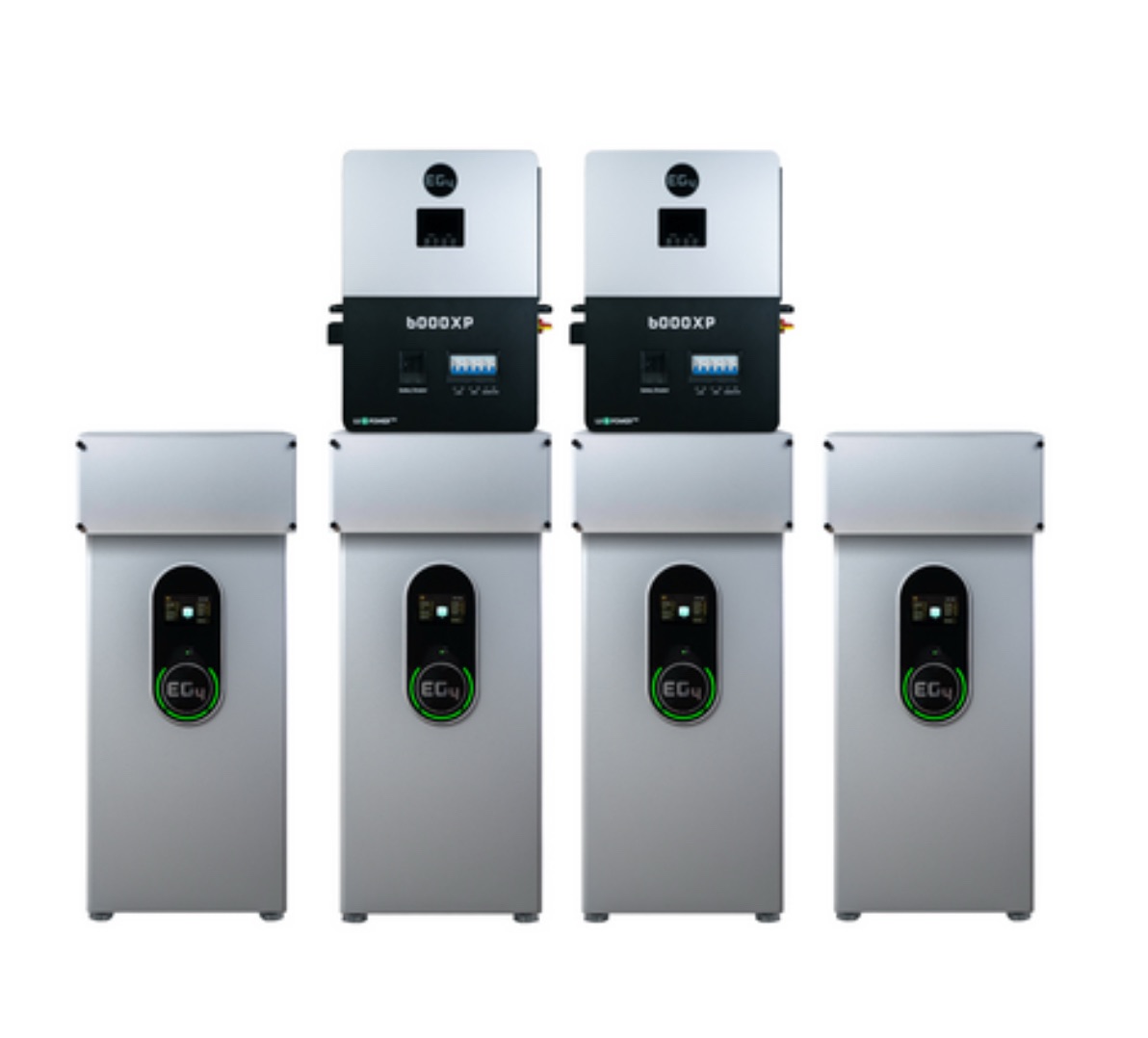
One of its biggest advantages is scalability. EG4 allows multiple 6000XP units to operate in parallel, so a homeowner can start small and expand later.
What Is the EG4 18kPV?
The EG4 18kPV is a much more capable all-in-one hybrid inverter designed for larger residential solar installations.
Despite the “18k” in its name, the inverter does not provide 18kW of continuous AC output.
Instead, the name primarily reflects its ability to accept up to 18kW of solar PV.
The inverter provides 12kW of continuous AC output and includes three MPPT solar inputs with a maximum DC input voltage of 600V.
More importantly, the 18kPV can function as a true grid-interactive hybrid inverter.
Depending on your installation and utility approval, it can:
- Power your home directly from solar
- Charge batteries from solar
- Charge batteries from the grid
- Operate during a grid outage
- Use the grid to supplement loads
- Export excess solar energy back to the utility
That last capability is one of the biggest differences between the 18kPV and 6000XP.
6000XP vs 18kPV: The Biggest Difference Isn’t Power
It’s tempting to think of the 18kPV as simply a larger 6000XP.
It isn’t.
The two products are designed around different system architectures.
The 6000XP is primarily an off-grid inverter. It can accept grid power for charging and supplemental power, but it isn’t designed as a grid-export inverter.
The 18kPV is a hybrid inverter designed to integrate directly with the utility grid while also supporting solar panels and batteries.
If your goal is simply to reduce how much electricity you buy from the utility while keeping the grid available as backup, both systems can potentially accomplish that.
If your goal includes sending excess solar power back to the grid, however, the 18kPV is the clear choice between these two.
Power Output: 6kW vs 12kW
The second major difference is continuous power output.
The EG4 6000XP can provide approximately:
6,000 watts continuous
The EG4 18kPV can provide:
12,000 watts continuous
That additional capacity can make a huge difference in a whole-home installation.
Imagine the following loads operating at the same time:
- Central AC: 3,500W
- Electric water heater: 4,500W
- Refrigerator: 200W
- Microwave: 1,500W
- Lighting and electronics: 500W
Total load:
10,200 watts
A single 6000XP obviously couldn’t continuously supply that combination.
A 12kW inverter has substantially more room for large household loads operating simultaneously.
Can You Just Use Two EG4 6000XPs Instead?
Absolutely.
This is where the comparison gets interesting.
Two EG4 6000XP inverters operating in parallel can provide approximately 12kW of combined continuous AC output.
That puts two 6000XPs in roughly the same continuous output category as one 18kPV.
For a DIY installer who doesn’t need grid export, this can be an extremely attractive option.
Advantages of Two 6000XPs
- Approximately 12kW total continuous output
- System redundancy
- Ability to start with one inverter and expand later
- Smaller and lighter individual units
- Potentially lower upfront cost when starting with one inverter
Redundancy can be particularly valuable.
If you have two inverters and one develops a problem, you may still be able to operate part of your system from the remaining inverter.
With one large inverter, losing the inverter could potentially take down the entire system until the problem is corrected.
Where the 18kPV Still Has a Big Advantage
Even if two 6000XPs provide similar AC output, they don’t automatically give you all the capabilities of an 18kPV.
The 18kPV provides several major advantages for larger solar installations.
1. Grid Export Capability
This is arguably the biggest difference.
The 18kPV is designed for grid-tied operation and can export excess solar production where utility rules and interconnection agreements allow it.
The 6000XP is designed as an off-grid inverter and isn’t intended for utility sell-back.
If net metering or grid export is part of your long-term plan, this alone may justify choosing the 18kPV.
2. More Solar PV Capacity
The EG4 6000XP supports up to approximately:
8kW of PV input
The EG4 18kPV supports up to:
18kW of PV input
That’s a massive difference if you’re planning a large rooftop or ground-mounted solar array.
An 18kW solar array could produce a substantial amount of energy during good conditions, giving you enough solar capacity to simultaneously power household loads and recharge a large battery bank.
3. Three MPPTs Instead of Two
The 6000XP includes two MPPT solar inputs.
The 18kPV includes three.
Having additional MPPTs gives you more flexibility when designing an array with panels facing different directions.
For example, you could potentially have separate strings for:
- East-facing panels
- South-facing panels
- West-facing panels
Keeping differently oriented arrays on separate MPPTs can help maximize production throughout the day.
4. Higher PV Voltage Capability
The 6000XP accepts PV input up to 480VDC.
The 18kPV supports up to 600VDC.
Higher-voltage strings can allow more panels to be connected in series, which can reduce current and potentially reduce conductor requirements over longer distances.
String voltage must always be calculated carefully using the solar panel’s open-circuit voltage and the lowest expected outdoor temperature.
What About Battery Capacity?
Both systems are designed around approximately 48V battery banks.
However, the amount of battery storage you need depends much more on your loads than on which inverter you purchase.
A typical 51.2V 100Ah LiFePO4 battery stores approximately:
51.2V × 100Ah = 5.12kWh
That means:
- 1 battery = approximately 5.12kWh
- 2 batteries = approximately 10.24kWh
- 3 batteries = approximately 15.36kWh
- 4 batteries = approximately 20.48kWh
- 6 batteries = approximately 30.72kWh
However, battery energy capacity is only part of the equation.
You also need enough battery discharge capability to supply the inverter.
At approximately 48V, producing 12,000 watts can require roughly:
12,000W ÷ 48V = 250 amps
Actual DC current can be higher after accounting for inverter losses and battery voltage.
That means your battery bank, BMS limits, busbars, cables, fuses, and disconnects must all be capable of safely handling substantial DC current.
Which Is Better for Central Air Conditioning?
Either inverter can potentially operate central air conditioning, but HVAC equipment is where the 18kPV’s additional output becomes especially useful.
A central AC compressor may require several thousand watts while operating and considerably more power during startup.
A compatible soft starter can reduce compressor starting current, but you still need enough continuous inverter capacity for the AC plus everything else operating in your home.
With a 6000XP, a large air conditioner can consume a substantial percentage of the inverter’s available output.
With 12kW available from the 18kPV, there is considerably more room for appliances, lighting, refrigeration, and other loads to operate simultaneously.
What About EV Charging?
Electric vehicle charging is another situation where inverter capacity disappears quickly.
A Level 2 charger operating at 240V and 24 amps consumes:
240V × 24A = 5,760W
That’s nearly the entire continuous capacity of a single 6000XP.
At 32 amps:
240V × 32A = 7,680W
That already exceeds the continuous output rating of one 6000XP.
A 12kW system makes EV charging much more practical, although charging power may still need to be managed when other large loads are running.
Which One Is Better for an Off-Grid Home?
This is where the 6000XP becomes especially attractive.
If your home isn’t connected to the grid—or you simply have no intention of exporting electricity—the additional grid-interactive capabilities of the 18kPV may provide little benefit.
In that situation, you may be better served by:
- One 6000XP for modest loads
- Two 6000XPs for approximately 12kW of output
- A larger battery bank
- More solar panels
- A backup generator
Instead of spending additional money on grid-interactive functionality you won’t use, you can put that money toward battery storage or solar capacity.
Which One Is Better for a Grid-Tied Home?
If you’re connected to the utility and want a sophisticated whole-home solar and battery system, the 18kPV becomes much more attractive.
It can coordinate:
- Solar production
- Battery charging
- Battery discharging
- Household loads
- Grid power
- Grid export where allowed
- Generator integration
This makes it a much more natural choice for a professionally permitted or advanced DIY whole-home energy system.
Is the EG4 18kPV Worth the Extra Money?
It depends entirely on what you’re trying to accomplish.
The EG4 6000XP Makes More Sense If:
- You’re building an off-grid solar system
- You don’t need to sell electricity back to the grid
- Your loads are generally under 6kW
- You want to start small and expand later
- You want a relatively simple DIY installation
- You would rather spend more of your budget on batteries and panels
The EG4 18kPV Makes More Sense If:
- You want a true whole-home hybrid solar system
- You need approximately 12kW of continuous inverter capacity
- You want utility grid integration
- You want the ability to export solar power where permitted
- You plan to install a large solar array
- You need three MPPT inputs
- You want to operate several large household loads simultaneously
- You want more flexibility for future system expansion
EG4 6000XP vs 18kPV: Final Verdict
For many DIY solar installations, the EG4 6000XP may actually be the better value.
It provides 120/240V split-phase power from a single unit, supports a substantial solar array, works with 48V batteries, and can be paralleled if you need more capacity later.
For an off-grid cabin, workshop, garage, backup power system, or even certain whole-home installations, it can be extremely capable.
But the EG4 18kPV is in a different class when it comes to whole-home grid integration.
Its 12kW continuous output, 18kW solar input, three MPPTs, 600V PV capability, and grid-export functionality make it much better suited to homeowners building a serious grid-connected solar and battery system.
So the simplest answer is:
If you don’t need grid export and 6kW is enough, buy the 6000XP.
If you’re building a large grid-connected whole-home solar system, the additional capabilities of the 18kPV can absolutely justify the extra cost.
And if you need around 12kW but still don’t care about grid export, don’t overlook another option: two EG4 6000XPs in parallel.
Frequently Asked Questions
Is the EG4 18kPV an 18,000-watt inverter?
No. The EG4 18kPV supports up to approximately 18kW of solar PV input, but its continuous AC output rating is 12kW.
What is the difference between the EG4 6000XP and 18kPV?
The 6000XP is a 6kW off-grid inverter with 8kW of PV input, while the 18kPV is a 12kW hybrid grid-interactive inverter supporting up to 18kW of PV. The 18kPV can also export power to the utility grid where permitted.
Can the EG4 6000XP sell power back to the grid?
No. The 6000XP is designed primarily as an off-grid inverter with grid input capabilities. If utility sell-back is required, a grid-interactive hybrid inverter such as the EG4 18kPV is the more appropriate choice.
Can two EG4 6000XP inverters replace one 18kPV?
Two 6000XP inverters can provide approximately 12kW of combined continuous AC output, but they do not provide all of the grid-interactive capabilities of the 18kPV. The best configuration depends on whether you need grid export, PV capacity, redundancy, and other features.
How many solar panels can the EG4 6000XP handle?
The EG4 6000XP supports up to approximately 8kW of usable solar PV input. The exact number of panels depends on panel wattage, open-circuit voltage, operating voltage, current, temperature, and how the panels are divided between the inverter’s MPPT inputs.
How many solar panels can the EG4 18kPV handle?
The EG4 18kPV supports up to approximately 18kW of PV input. The exact number of panels depends on their electrical specifications and string configuration rather than simply their wattage.
Disclaimer: Solar panels, batteries, and inverters involve potentially lethal AC and DC voltages. This article is intended for general educational purposes only. Always follow current manufacturer documentation, applicable NEC requirements, local building codes, permitting requirements, and utility interconnection rules. Consult a qualified electrician or solar professional when appropriate.