EG4 6000XP vs EG4 12000XP
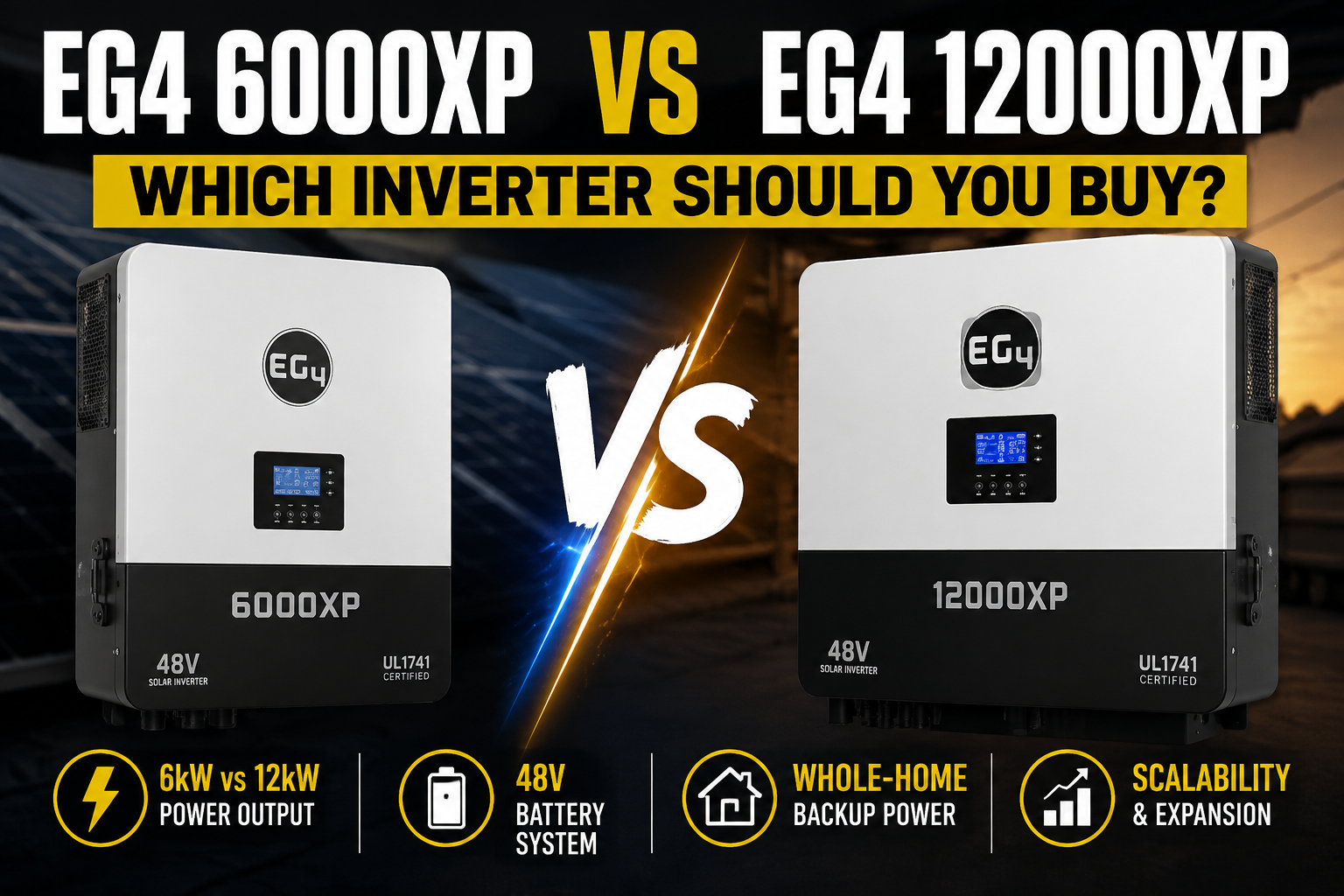
If you’re building a DIY solar system and considering an EG4 inverter, there’s a good chance you’ve narrowed your choices down to the EG4 6000XP and EG4 12000XP. Both are 48V split-phase hybrid inverters designed for whole-home and off-grid solar applications, but there are some important differences between them.
The biggest question is simple: Is the EG4 12000XP worth buying, or are you better off using one or more EG4 6000XP inverters?
In this guide, we’ll compare the EG4 6000XP vs EG4 12000XP, including power output, battery requirements, expandability, solar capacity, and which inverter makes the most sense for different DIY solar installations.
EG4 6000XP vs 12000XP: Quick Comparison
| Feature | EG4 6000XP | EG4 12000XP |
|---|---|---|
| Battery Voltage | 48V | 48V |
| AC Output | 6,000W | 12,000W |
| Output | 120/240V split phase | 120/240V split phase |
| Best For | Smaller or modular systems | Larger whole-home systems |
| Expandable | Yes | Yes |
The most obvious difference is output. A single EG4 6000XP provides 6kW of continuous output, while the EG4 12000XP provides 12kW.
However, inverter size alone doesn’t tell the whole story.
What Is the EG4 6000XP?
The EG4 6000XP is a 48V split-phase inverter that has become extremely popular with DIY solar installers.
One major advantage is that it produces 120V and 240V split-phase power from a single inverter. That means it can power normal 120V household circuits while also supporting 240V loads such as well pumps, dryers, water heaters, and certain HVAC systems.
At 6,000 watts of continuous output, one 6000XP can handle a substantial number of household loads.
Its biggest advantage, however, is modularity.
You can start with one inverter and add another later as your electrical needs increase.
Two EG4 6000XPs provide approximately 12kW of combined inverter capacity, putting the system into the same general power category as a 12000XP.
For homeowners building a DIY solar system gradually, this can be a major advantage.
What Is the EG4 12000XP?
The EG4 12000XP takes the same general concept and moves it into a larger power category.
Instead of needing two 6kW inverters to reach approximately 12kW of continuous output, you can accomplish that with one larger inverter.
For a whole-home solar installation, this can simplify the system considerably.
Rather than installing multiple inverters, additional AC wiring, communication cables, breakers, and mounting hardware, you can potentially accomplish the same basic goal with one 12000XP.
That makes the 12000XP particularly attractive for someone who already knows they need around 12kW of inverter capacity.
The Biggest Difference: 6kW vs 12kW
The most important consideration when comparing these two inverters is how much power your house may demand at one time.
A 6,000-watt inverter does not mean your house can only consume 6,000 watts per day. It means the inverter can continuously supply approximately 6,000 watts at one time.
For example, you might be running:
- Refrigerator – 150W
- Freezer – 150W
- Lights – 300W
- TVs and electronics – 300W
- Microwave – 1,500W
- Miscellaneous household loads – 500W
Even with all of those running, you could remain below the output capacity of a single 6000XP.
The problem comes when larger loads begin operating simultaneously.
Add a central air conditioner, electric water heater, clothes dryer, range, well pump, or EV charger and your electrical demand can climb quickly.
That’s where having 12kW of inverter capacity becomes much more useful.
Two EG4 6000XPs vs One EG4 12000XP
This is probably the comparison most DIY solar installers really care about.
If two 6000XPs can provide roughly the same continuous output as one 12000XP, why choose one configuration over the other?
Advantages of Two EG4 6000XPs
The first major advantage is redundancy.
With two independent inverters, losing one inverter doesn’t necessarily mean losing your entire solar power system. Depending on how your installation is configured, the remaining inverter may still provide limited power while the other unit is repaired or replaced.
The second major advantage is scalability.
You can purchase one EG4 6000XP today and add another later.
For example:
Phase 1:
EG4 6000XP + battery bank + solar panels
Phase 2:
Second EG4 6000XP + additional batteries + additional solar panels
This allows you to spread the cost of a larger solar system over time.
Advantages of the EG4 12000XP
The biggest advantage of the 12000XP is simplicity.
One inverter can mean:
- Less wall space
- Fewer electrical connections
- Less communication wiring
- Fewer breakers and disconnects
- Simpler troubleshooting
- A cleaner overall installation
If you’re starting from scratch and already know you need approximately 12kW of inverter capacity, installing one appropriately sized inverter can make more sense than building a parallel inverter system.
Don’t Forget About Your Battery Bank
One of the biggest mistakes beginners make is choosing a powerful inverter without considering how much current it can pull from the battery bank.
The basic formula is:
Watts ÷ Volts = Amps
A 12,000W load from a nominal 48V battery system represents roughly:
12,000 ÷ 48 = 250 amps
Actual battery current can be even higher once inverter losses and changes in battery voltage are considered.
That’s a substantial amount of DC current.
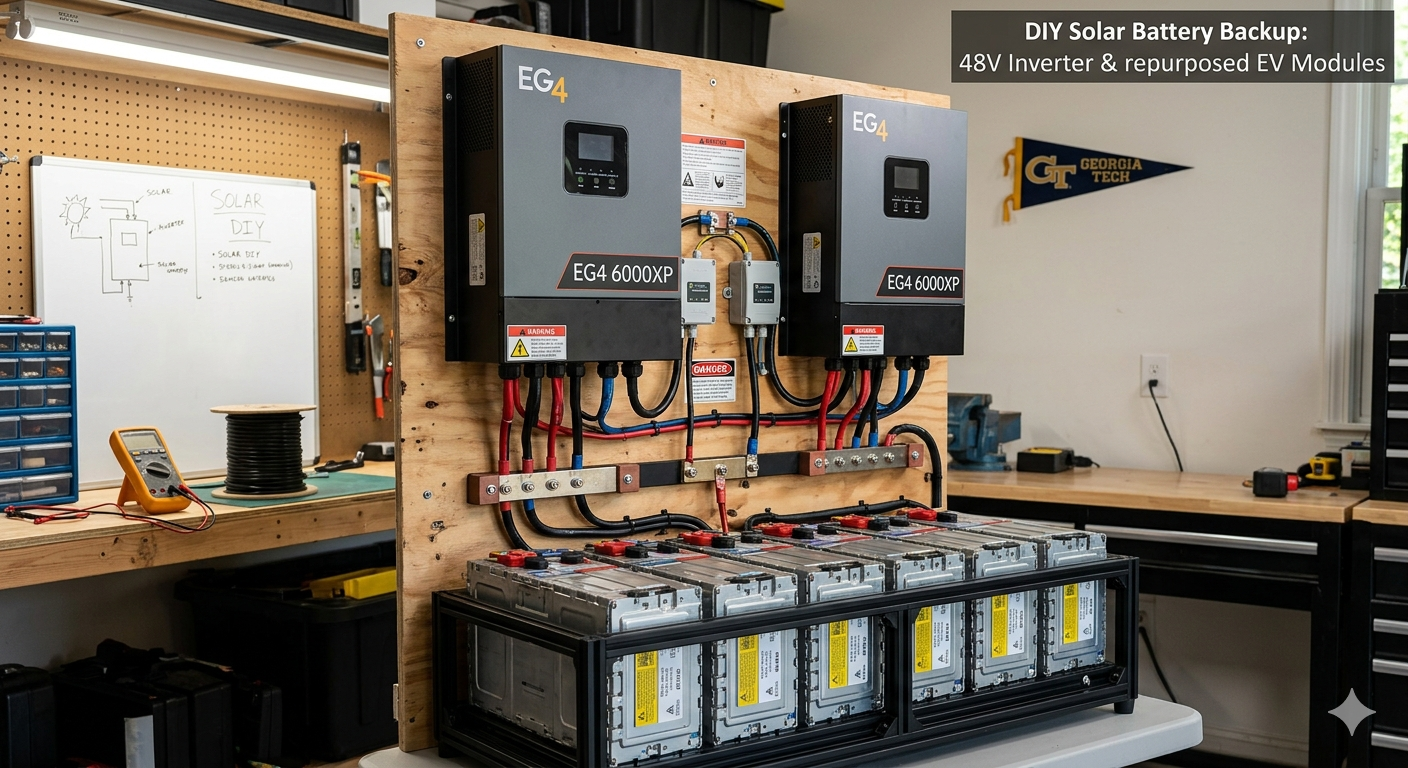
Your batteries, busbars, battery cables, fuses, disconnects, and battery management systems all need to be capable of supporting that amount of power.
This is why pairing a large inverter with a very small battery bank isn’t necessarily a good idea.
How Much Battery Capacity Do You Need?
Battery capacity is measured in kilowatt-hours (kWh), while inverter output is measured in kilowatts (kW).
They’re related, but they aren’t the same thing.
For example, a common 48V 100Ah LiFePO4 battery stores approximately:
51.2V × 100Ah = 5.12kWh
That means:
- 1 battery = approximately 5.12kWh
- 2 batteries = approximately 10.24kWh
- 3 batteries = approximately 15.36kWh
- 4 batteries = approximately 20.48kWh
Adding batteries not only increases runtime but can also increase the amount of current your battery bank can safely deliver when properly connected in parallel.
Always verify the battery manufacturer’s maximum continuous discharge current when designing your battery bank.
Which One Is Better for Running Air Conditioning?
Air conditioning is one of the biggest reasons homeowners move toward larger solar inverters.
A central HVAC system may consume only a few thousand watts while running, but compressor startup demand can be considerably higher.
Installing a compatible soft starter can dramatically reduce compressor startup current and make running central air from a solar inverter much easier.
For a house with one moderate-size central AC system, a 6000XP may be sufficient depending on what other loads are operating at the same time.
For homes with multiple HVAC systems or several large electrical appliances, 12kW of inverter capacity gives you substantially more breathing room.
What About Charging an Electric Vehicle?
EV charging can consume a huge portion of a 6kW inverter’s available output.
For example, a Level 2 EV charger operating at 240V and 24 amps uses:
240V × 24A = 5,760W
That’s nearly the entire continuous output of a single EG4 6000XP.
At 32 amps:
240V × 32A = 7,680W
That already exceeds 6kW.
With a 12kW inverter system, EV charging becomes much more practical while still leaving capacity available for other household loads.
That doesn’t necessarily mean you should charge your EV entirely from your batteries. During daylight hours, a properly sized solar array can supply a significant portion of the charging power directly through the system.
Solar Array Size Matters Too
Don’t choose your inverter based only on household load. You should also think about how much solar you eventually want to install.
A DIY solar system often starts small and grows over time.
You might begin with 5kW of solar panels but eventually expand to 10kW, 15kW, or more.
Before purchasing either inverter, check the current manufacturer specifications for:
- Maximum PV input
- Maximum PV open-circuit voltage
- MPPT operating voltage range
- Number of MPPT inputs
- Maximum input current per MPPT
- Recommended maximum solar array size
These specifications determine how your solar panels can safely be arranged into strings.
Never design a solar string based only on panel wattage. Panel voltage, especially cold-weather open-circuit voltage, is critical when determining whether a string is safe for an inverter.
Which Inverter Should You Buy?
Choose the EG4 6000XP If:
- Your simultaneous household loads are generally below 6kW
- You want to start with a smaller solar system
- You plan to expand your system later
- You want the flexibility of adding another inverter in the future
- Redundancy is important to you
- You want to spread your solar investment over time
Choose the EG4 12000XP If:
- You already know you need around 12kW of inverter capacity
- You want to run multiple large household loads at once
- You have multiple HVAC systems
- You plan to charge an EV from your solar system
- You want a simpler single-inverter installation
- You are designing a larger whole-home backup system from the beginning
EG4 6000XP vs 12000XP: Final Verdict
There really isn’t one winner for every DIY solar installation.
The EG4 6000XP makes a lot of sense for smaller systems, budget-conscious builds, and homeowners who want the ability to expand gradually.
The EG4 12000XP makes more sense when you’re designing a larger whole-home system from the beginning and want enough inverter capacity to comfortably operate several high-demand loads simultaneously.
If you’re unsure, start by calculating your home’s maximum simultaneous load rather than simply looking at your monthly electric bill.
Your monthly electricity usage tells you how much energy you consume. Your inverter needs to be sized based on how much power you may need at any one time.
Getting that distinction right can save you from buying an inverter that’s either unnecessarily expensive or too small for your home.
Frequently Asked Questions
Can two EG4 6000XP inverters provide 12kW?
Two properly configured EG4 6000XP inverters can provide approximately 12kW of combined continuous inverter capacity. Always follow the manufacturer’s current parallel installation and wiring requirements.
Is a 6000XP enough to run a whole house?
It can be, depending on your loads. Homes with gas appliances and relatively modest electrical demand may operate comfortably from a 6kW inverter. Homes with electric HVAC, water heating, cooking, dryers, or EV charging may need considerably more inverter capacity.
Can the EG4 6000XP run central air conditioning?
Potentially, yes. The answer depends on the HVAC system’s running wattage, compressor startup current, and what other loads are operating simultaneously. A compatible soft starter can help reduce startup demand.
How many batteries do I need for a 12kW inverter?
There isn’t one universal answer. Your battery bank must provide both enough energy capacity for your desired runtime and enough discharge current to support the inverter’s maximum load. Always check the continuous discharge rating of each battery and the manufacturer’s system requirements.
Should I buy one 12000XP or two 6000XPs?
If you want a simpler installation and already know you need approximately 12kW, the 12000XP may be the better choice. If you prefer modular expansion and inverter redundancy, two 6000XPs can be very attractive.
Disclaimer: Solar and battery systems involve potentially lethal AC and DC voltages. This article is intended for general educational purposes only. Follow all manufacturer installation instructions, applicable electrical codes, and permitting requirements. Consult a qualified electrician when necessary.